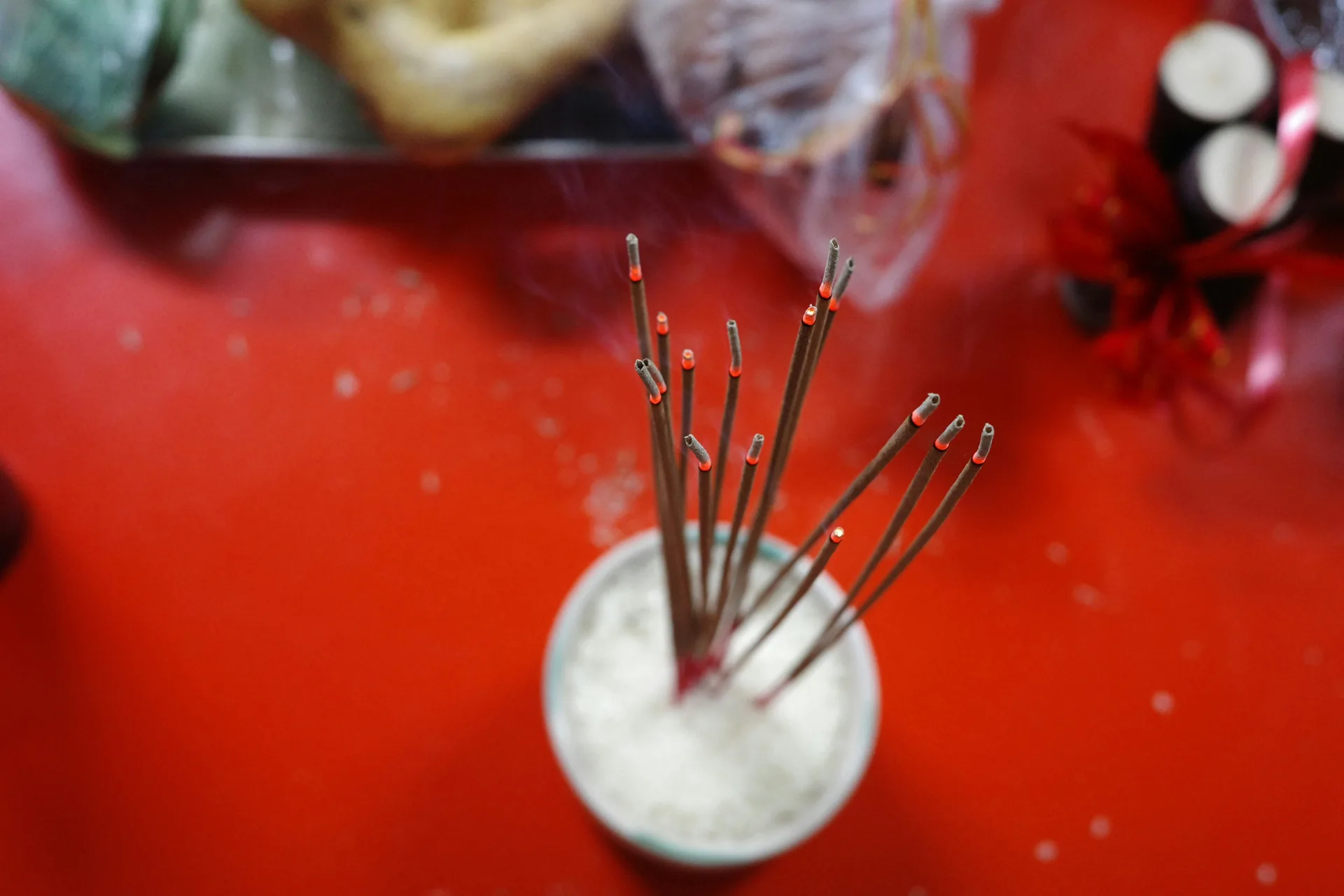
Before the Day Begins
In many traditional Chinese Malaysian households, the first act of every morning has nothing to do with coffee or a phone screen. It is the walk to the altar. Three joss sticks are lit, held between both palms, and raised to the forehead. Three bows follow. Then the sticks are pressed into the urn, and the smoke begins to rise, thin and white, carrying whatever the person has quietly said upward, into something older than any of them.
This is the morning incense offering, known in Hokkien as hioh hio (燒香) or simply as "pai sin" (拜神), to pay respect to the deities. It is one of the most intimate, most consistent, and least documented rituals in Chinese Malaysian life. It happens before sunrise, before the children wake, before the day has had a chance to become complicated. And it has been happening, in one form or another, in Chinese households across the Malay Peninsula for well over a century.
The Altar: A World Within a Cabinet
The home altar, or sin toh (神桌), is the gravitational centre of a traditional Chinese Malaysian home. It is almost always placed facing the main door: so that blessings can flow in and negative energies cannot settle. In a shophouse, it occupies the rear of the ground floor. In a terrace house, it takes the highest point of the living room wall.
At the centre sits the presiding deity figure. Which deity depends entirely on the family's lineage, dialect group, and devotion. Guan Yin (觀音), the Goddess of Mercy, is the most common across all communities. Hokkien households often venerate Tua Pek Kong (大伯公), the Earth God of fortune and community, alongside the Jade Emperor (天公, Thian Kong). Cantonese families may centre the altar on Guan Di (關帝), the God of righteousness and brotherhood. Hakka and Teochew altars may feature Tua Di Ya (大地爺) or a patron deity specific to the family's ancestral village.
To the sides of the deity figurine, or on a lower shelf just behind, sit the ancestor tablets, rectangular wooden or paper plaques inscribed with the names of the deceased. These are not decorative. They are presences. The ancestor tablets anchor the ritual: prayers are addressed both to the gods and to the family's own dead, in one continuous gesture of respect.
In front of all this: an incense urn filled with ash, a pair of red candles in brass holders, a vase of fresh flowers when available, and one or two small cups containing tea, water, or rice wine. Some altars hold an oil lamp whose flame is never allowed to go out, chang ming deng (長明燈), the eternal light.
Why Three Joss Sticks
The number three is not arbitrary. In Chinese cosmology, three represents the triad of Heaven, Earth, and Humanity, the three forces that must be in alignment for a life to be balanced. One stick for Heaven, one for Earth, one for the Ancestors. Some households light five sticks on special occasions (adding the cardinal directions) but for daily prayer, three is the standard across virtually all dialect communities.
The joss sticks themselves (hio in Hokkien, heung (香) in Cantonese) are typically bamboo-core sticks coated in a fragrant wood powder compound. Red-core sticks are used for deity worship; plain wood or sandalwood sticks are considered appropriate for ancestor tablets. In more devout households these distinctions are carefully observed.
The smoke carries the prayer. This is the underlying logic of incense across nearly every tradition that uses it: that fragrance is a medium, a vehicle that crosses the boundary between the visible and the unseen. In Chinese practice, the scent rising from the urn is understood as a form of nourishment for the spirits and as a signal to the deities that the household is present and attentive.
The Sequence
The exact words spoken at a morning incense offering vary by family, dialect group, and the deity being addressed. But the physical sequence is broadly consistent across Chinese Malaysian communities. The worshipper first lights both candles flanking the urn, then uses one candle flame to light the joss sticks, never blowing them out with the mouth, as breath is considered impure in the space of the altar. The sticks are waved gently or fanned to achieve an even burn.
Holding the lit sticks between both palms at chest height, the worshipper bows three times: once toward the deity, once toward the ancestor tablets, and a final bow to consolidate the intention. On the third bow, the sticks are lowered and pressed carefully into the incense urn, the tallest inserted last. Fresh offerings (fruit, a cup of tea, a small dish of sweets) may be placed on the altar before the prayer, and water in the flower vase is changed regularly.
What is said aloud varies. Many families recite a fixed prayer, learned by ear from a parent or grandparent, that opens by naming the deity and the household address, states the date according to the lunar calendar, and asks for blessing, health, and protection for each family member by name. Others pray in quiet improvisation, the words changing with whatever the household is carrying that particular morning: a sick child, an exam, a difficult month at work.
Who Does It, and When It Is Passed On
In most households, the morning incense offering falls to the family matriarch. Grandmothers and mothers are the custodians of the altar in Chinese Malaysian life, responsible for keeping the offerings fresh, ensuring the oil lamp is filled, and maintaining the daily rhythm of prayer. It is not uncommon for this role to be inherited formally: when a mother grows too old or too unwell to maintain the altar, she instructs a daughter or daughter-in-law to take over, teaching the sequence, the correct words, and the particular sensitivities of each deity the family venerates.
Among Hokkien families, the practice tends to be most elaborate, with specific prayers recited on the first and fifteenth day of each lunar month (the new moon and full moon days), when additional offerings of cooked food, red tortoise cakes, and incense paper are added. Cantonese and Hakka households may keep the daily practice simpler but intensify it around the deity's birthday, an annual occasion marked in the Chinese almanac.
The morning incense offering is also the thread that connects the daily to the extraordinary. The same altar where a grandmother lights three sticks every morning becomes, on Chinese New Year's Eve, the site of the family's most formal annual prayer. The same deity who receives daily smoke receives the household's most elaborate offerings on Tian Gong's birthday on the ninth day of the first lunar month. The daily ritual is, in this sense, a form of relationship maintenance, keeping the connection open so that when something truly important needs to be asked, the channel is already warm.
A Practice Under Pressure
The morning incense offering does not appear in heritage brochures or tourism campaigns. It has no spectacle, no costume, no occasion that marks it on a public calendar. This has always been both its vulnerability and its resilience, a tradition so embedded in the private life of the home that it was never dependent on any external infrastructure to survive.
But it is under pressure. Urban apartment living makes a full altar difficult. Younger generations, many of whom grew up watching but not learning the sequence, find themselves without the words when the responsibility passes to them. The exact prayers, learned by ear in a dialect that may no longer be spoken fluently in the household, are among the most at-risk elements of Chinese Malaysian intangible heritage.
Some families have adapted. Simpler altars. Fewer sticks. Prayer apps and printed phonetic guides for children who understand the meaning but not the language. What remains constant, even in the most minimal versions, is the gesture itself. Hands together. A bow. A moment of acknowledgement, before the day begins.