A Festival Built Around a Poet and a River
Every tradition begins somewhere. The Dragon Boat Festival begins with a man standing at the bank of a river in ancient China, his country falling apart around him, choosing to walk into the current rather than watch from the shore. That man was Qu Yuan (屈原), a poet and statesman of the kingdom of Chu during the Warring States period, roughly 340 to 278 BCE. His death gave the world one of its most enduring festivals, and his story has been carried by Chinese communities to every corner of the globe, including to the shores of the Malay Peninsula.
In Malaysia, the Dragon Boat Festival is known by several names depending on the community observing it. In Mandarin it is Duanwu Jie (端午节), meaning the festival of the upright noon. In Cantonese it is Tuen Ng. In the Hokkien communities that form the backbone of Chinese Malaysian life in Penang and across the northern states, it is called Peh Cun, a term that refers to the rowing of the boats and carries within it the physical memory of paddles cutting water in urgency and grief. Across all these names and all these communities, the festival falls on the same day: the fifth day of the fifth lunar month, a date charged in the Chinese calendar with both danger and the power to ward it off.
Qu Yuan did not die quietly. He drowned in protest, in grief, in the conviction that loyalty to a broken state was still loyalty. The festival that followed is, at its heart, a community's refusal to let that act go unmarked.
The Legend of Qu Yuan: Why the Boats Race
Qu Yuan was not a simple figure. He served as a trusted minister to King Huai of Chu, one of the major kingdoms of the Warring States period, a time of fragmentation and constant war across the territories that would eventually become unified China. He was a poet of unusual power and a statesman of genuine conviction, and he advocated consistently for his kingdom to resist the growing dominance of the Qin state to its west.
His counsel was not always welcome. Court rivals worked against him, feeding the king's suspicions, and Qu Yuan was eventually accused of disloyalty and sent into exile from the court he had served. He spent years in the wilderness of southern China, writing the poems that would later be collected as the Chu Ci, among the oldest and most celebrated works in the Chinese literary canon. His poetry carried his grief and his unbroken love for a kingdom that had rejected him.
When news reached him in 278 BCE that the Qin forces had captured Ying, the capital of Chu, Qu Yuan understood that what he had feared and warned against had come to pass. He walked to the bank of the Miluo River, in what is now Hunan province, and drowned himself on the fifth day of the fifth month. He was roughly sixty years old.
The people who lived along the river had loved and respected him. When they heard what had happened, they rushed out in their boats, beating drums and splashing the water with oars to frighten away the fish and evil spirits that might harm his body. They threw rice wrapped in leaves into the water to feed his spirit. They searched for him and did not find him. The searching became a race, the rice offerings became a tradition, and the tradition became a festival observed two thousand years later by families in Penang wrapping bamboo leaves by lamplight the night before the fifth day of the fifth month.
The Double Fifth: What the Date Means
The fifth day of the fifth lunar month was already considered a significant and somewhat dangerous day in the Chinese almanac long before Qu Yuan's death gave it its defining story. The number five in combination, and the mid-point of the year approaching the summer heat, was associated in traditional Chinese cosmology with the peak of yang energy: intense, powerful, and if not properly managed, harmful. Insects multiplied. Diseases spread. The heat brought sickness into homes that had been healthy through the cool months.
The festival's protective customs grew from this understanding. The day was not only a day of mourning for a poet. It was a day for driving out what was harmful, purifying the household, and fortifying the family against the dangers of the summer ahead. Qu Yuan's story gave emotional weight to practices that had their own older roots in seasonal ritual and folk medicine, and the two strands wound together over centuries into the festival as it is observed today.
How Malaysian Chinese Observe the Festival
For the Chinese Malaysian community, the Dragon Boat Festival is observed in ways that are both shared across all dialect groups and shaped by the specific character of each community. The Hokkien observe it with particular intensity, the Cantonese bring their own culinary emphases, and the Peranakan Baba Nyonya tradition adds its distinctive hybrid flavour to the occasion. But in every household, across every community, the festival turns on two axes: food and protection.
The Customs of the Day
Across Chinese Malaysian households, the morning of the Dragon Boat Festival is marked by a set of practices that link the domestic to the sacred. The altar is prepared before dawn. Offerings of food are laid out and incense is lit to honour the ancestors and to ask for the family's protection through the summer months. In many households, the day begins with the same quiet ritual that begins every important festival: three joss sticks, three bows, and a prayer spoken low enough that only the household deities can hear it.
Hanging Calamus and Mugwort
Bundles of calamus (菖蒲, chang pu) and mugwort (艾草, ai cao) are tied with red thread and hung at the front door or above the entrance of the home. Calamus leaves are long and blade-shaped, resembling a sword, and in Taoist practice a sword is the instrument that drives out evil. Mugwort carries a sharp herbal scent believed to repel insects and ward off harmful spirits. Together, they transform the doorway into a threshold of protection. In some households, garlic, ginger, and pomelo leaves are added to the bundle, each chosen for its purifying properties.
Noon Water
On the Dragon Boat Festival, the hour of noon carries particular significance. The sun is at its highest, its yang energy at its most concentrated, and water drawn precisely at noon is believed to carry that energy within it. Families collect water from the tap or a well at noon and use it to bathe, particularly the children, who are washed with this water as a form of purification and protection. The practice of noon water bathing has faded in many urban households but persists among older generations, especially in Penang and Ipoh, where traditional customs have held their ground against the erosion of modern convenience.
Ancestor Offerings
The Dragon Boat Festival is an occasion for formal ancestor veneration in many Chinese Malaysian households. The altar is laden with the foods of the season, bak chang foremost among them, alongside fruit, tea, and the incense paper that carries offerings to the other world. The family gathers before the altar in order of seniority. The eldest speaks the names of those being remembered. It is a moment in which the festival's origin story is quietly present: a community honouring someone who could not be saved, insisting that the memory of care outlasts the person it was directed to.
Wearing Fragrant Sachets
Particularly for children, the Dragon Boat Festival tradition of wearing small fragrant sachets (香包, xiang bao) persists in some families. These are small cloth pouches stuffed with dried herbs including realgar, atractylodes, cloves, and dried orange peel, sewn into decorative shapes and hung around the neck or pinned to clothing. The scent is sharp and medicinal. They are understood to protect children from illness during the height of summer, and making them is an act of care that grandmothers perform in the days before the festival. In Penang's older communities, hand-sewn sachets in the shapes of tigers, fish, and lotus flowers are still made and given to the youngest members of the household.
The Dumplings: A Festival Told in Leaves and Rice
No aspect of the Dragon Boat Festival is more central to the Chinese Malaysian experience than the making and eating of bak chang (肉粽), the glutinous rice dumplings wrapped in bamboo or reed leaves and boiled for hours over low heat. If the dragon boat race is the festival's drama, the bak chang is its daily life: the thing that happens in the kitchen three days before, that fills the house with steam and the smell of five-spice and rendered pork fat, that is made in large batches and distributed to neighbours and relatives whether they ask for them or not.
The connection between the dumplings and Qu Yuan is direct and documented in the legend. The villagers who rushed to the Miluo River to search for the poet's body threw rice into the water to feed his spirit and to distract the fish and river dragon from consuming him. Over time, the rice was wrapped in leaves to give it form and protection against the water. The shape we recognise today, the compact pyramid of glutinous rice bound tight in dried bamboo leaves, is the descendant of that first act of offering.
The Dumplings of the Chinese Malaysian Table
Each dialect group and community has its own version. A family's bak chang is a map of where they came from.
The Dragon Boats: Racing as Remembrance
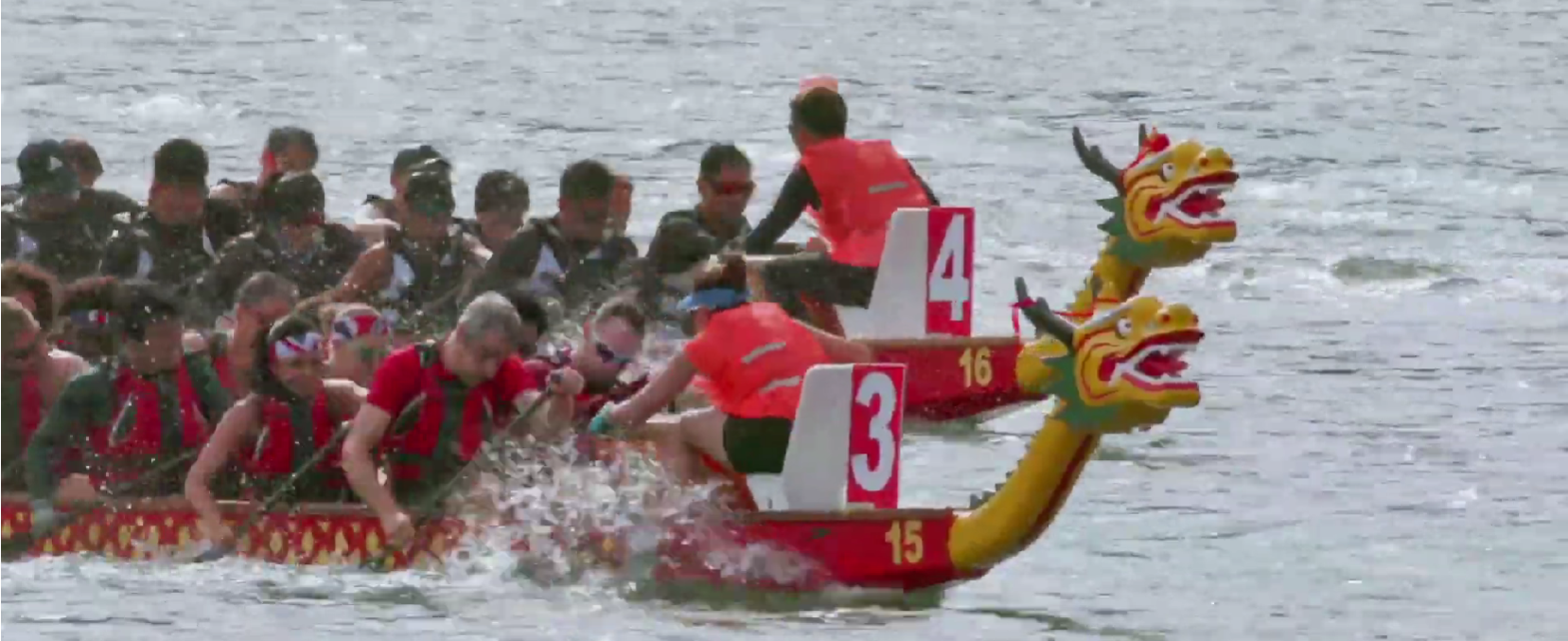
Dragon boat racing is the most spectacular face of the festival, and it is the element that has travelled furthest beyond its community of origin, now practised competitively on rivers, lakes, and reservoirs across more than sixty countries. But within Chinese Malaysian life, it carries a meaning that sporting competition alone does not account for. To race a dragon boat is to reenact, in the most physical way possible, the original act of love and grief that the festival commemorates: a community in boats, searching.
In Malaysia, Penang holds the distinction of being the first place outside mainland China to formalise dragon boat racing as a competitive sport, with the first organised races held in 1956 on the waters off the island's coast. The Penang International Dragon Boat Festival has since grown into one of the most prominent events of its kind in Southeast Asia, drawing teams from across the region and beyond. The boats used in formal competition are long, narrow, and built to carry between twenty and fifty paddlers, with a drummer seated at the bow keeping the rhythm that synchronises every stroke.
The preparation of a competition dragon boat follows a ritual sequence that is older than the race itself. Before the boat enters the water, it undergoes a ceremony called the awakening of the dragon, in which a Taoist priest or designated elder paints the eyes onto the carved dragon's head at the prow. The eyes are what bring the boat to life as a spiritual vessel, not merely a sporting craft. Incense is burned. Prayers are said. Only after this ceremony is complete is the boat considered ready for the water.
The Festival Across Different Communities
What is distinctive about the Dragon Boat Festival as observed in Malaysia is the way it accommodates different levels of participation without losing coherence. A family that wakes before dawn to lay offerings at the altar and spends the previous three days making bak chang from scratch is observing the same festival as a family that buys their dumplings from the market and goes to watch the boats race in the afternoon. The festival holds all of them.
| Community | Local Name | Distinctive Emphasis |
|---|---|---|
| Hokkien | Peh Cun | The most commonly used name for the festival in Malaysian Chinese daily speech. Strong emphasis on the making of bak chang as a communal family activity and on ancestor veneration at the household altar. |
| Cantonese | Tuen Ng Jit | Strong association with the dragon boat races. The Cantonese communities of Kuala Lumpur and Selangor have historically been active in competitive dragon boating and in the ceremonial aspects of the boat awakening ritual. |
| Teochew | Duanwu Jie | The Teochew kiam tee chang, with its distinct filling and looser texture, is considered a point of community pride. Clan associations in Johor and among the Teochew communities of the Klang Valley organise communal dumpling-making sessions in the days before the festival. |
| Baba Nyonya | Peh Cun / Nyonya Chang Festival | The Peranakan Chinese community is identified most strongly with nyonya chang, whose spiced filling and butterfly pea flower colouring have become one of the most recognised symbols of Malaysian Peranakan cuisine. In Melaka and Penang, nyonya chang is sold by specialist makers from the weeks before the festival. |
What Persists, and What Has Changed
Like all living traditions, the Dragon Boat Festival in Malaysia has shifted with time. The households that once spent three days making bak chang from scratch now often buy them from the market, from the specialist makers who set up stalls outside clan halls and wet markets in the weeks before the fifth day of the fifth month. The children who once wore hand-sewn fragrant sachets now sometimes receive them as gifts from grandparents who still know how to make them, rather than as a matter of course.
The protective customs, the noon water bathing, the hanging of calamus at the door, the fragrant sachets, have faded most in urban households and held on most stubbornly in the older residential areas of Penang, Ipoh, and Melaka, where the communities that brought these practices across the sea have lived on the same streets long enough to preserve them by proximity and habit.
What has not changed is the bak chang. Even in families where every other festival custom has been simplified or set aside, the bak chang persists. It is made or bought. It is eaten with family. It is often brought to the altar first, offered to the ancestors before the living eat. In this one act, the festival's full meaning is still intact: a community feeding its dead, honouring a poet who drowned in grief, carrying the memory of loyalty forward into a new year. The fifth day of the fifth month comes around every summer, and the leaves are folded, and the rice is packed in, and the pot is set to boil.