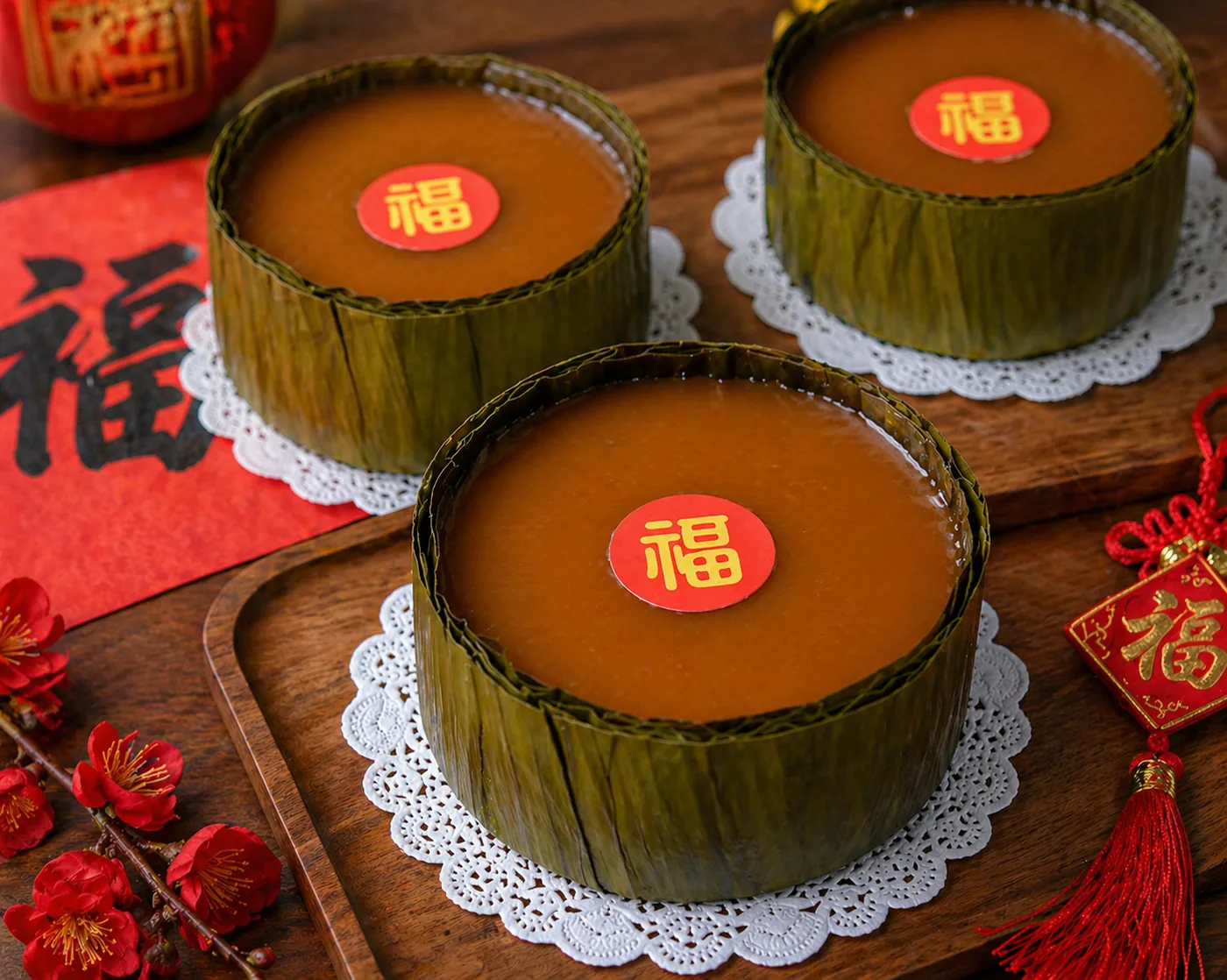
What It Is
Nian Gao (年糕) is a dense, sticky cake made from glutinous rice flour and brown sugar, steamed low and slow until it sets into a dark, chewy block. Its name is a homophone of "year higher" (年高), making it a symbol of growth, elevation, and improvement in the year ahead.
In Chinese Malaysian households, Nian Gao is one of the most important foods of the Chinese New Year season. The first batch off the steamer is never eaten by the family; it goes directly to the altar, offered to the ancestors before any human taste is taken. Only after the spirits have been fed can the living enjoy it.
The most common way to eat Nian Gao in Malaysia is sliced and pan-fried in egg, dipped in beaten egg and cooked until the outside is golden and slightly crisp while the inside remains molten and sweet. It can also be sandwiched between slices of yam or sweet potato before frying, a Hokkien variation that balances the sweetness with earthy depth.
The Heritage Food
Nian Gao: Steamed Sticky Rice Cake
- 450 g glutinous rice flour
- 300 g brown sugar or palm sugar (gula melaka)
- 400 ml warm water
- 2 tbsp vegetable oil
- 1 tsp vanilla extract (optional)
- Sesame seeds or red dates to garnish
- Dissolve the sugar in warm water, stirring until fully melted. Allow the syrup to cool slightly.
- Whisk in the vegetable oil and vanilla extract into the cooled sugar syrup.
- Gradually sift in the glutinous rice flour, whisking steadily until the batter is completely smooth with no lumps.
- Grease a round cake tin (18–20 cm diameter). Pour in the batter and scatter sesame seeds or red dates on top.
- Steam over medium heat for 45 to 60 minutes, until a skewer inserted in the centre comes out clean.
- Remove from the steamer and allow to cool completely, at least 4 hours, or overnight, before slicing. The cake firms up significantly as it cools.
- To serve, slice into pieces, dip in beaten egg, and pan-fry until the outside is golden and crisp while the inside stays soft and molten.
Across Malaysian Chinese communities, Nian Gao takes on different forms. In Penang, it is commonly sliced thin, sandwiched between rings of yam or sweet potato, dipped in egg batter, and deep-fried to golden perfection — a street-food staple sold in night markets through the festive season. In Kuala Lumpur and Johor, steamed Nian Gao served with fresh grated coconut is the preferred form, eaten warm from the bamboo steamer. Cantonese families sometimes pan-fry slices in a dry pan until caramelised and chewy on the outside. Hakka households may make a darker, more intensely flavoured version using raw brown sugar (gula Melaka) rather than refined sugar, giving it a deeper molasses note. Despite these variations, the symbolism is identical: to eat Nian Gao is to wish the family advancement — a higher station, better health, and greater prosperity — in the year to come.